


There's a version of the World Cup most of us know well: the couch, the group chat, the last-minute goal that sends everyone into chaos. It's wonderful. It's also just the beginning of what's possible.
The 2026 edition hosted across the United States, Mexico, and Canada is the largest World Cup in history. 104 matches. 16 cities. Three countries with wildly different football cultures, all sharing one moment. And with that scale comes something rare: a genuine window for immersive experiences to change how people connect with the beautiful game.
So what does that actually look like? Let's talk about some of the most exciting possibilities.
World Cup Immersive Experiences
Immersive experiences start with a simple idea: what if you weren't a passive observer? What if the event happened around you, and with you?
Some of the most compelling examples already exist and the World Cup is the perfect stage to scale them:
Example 01
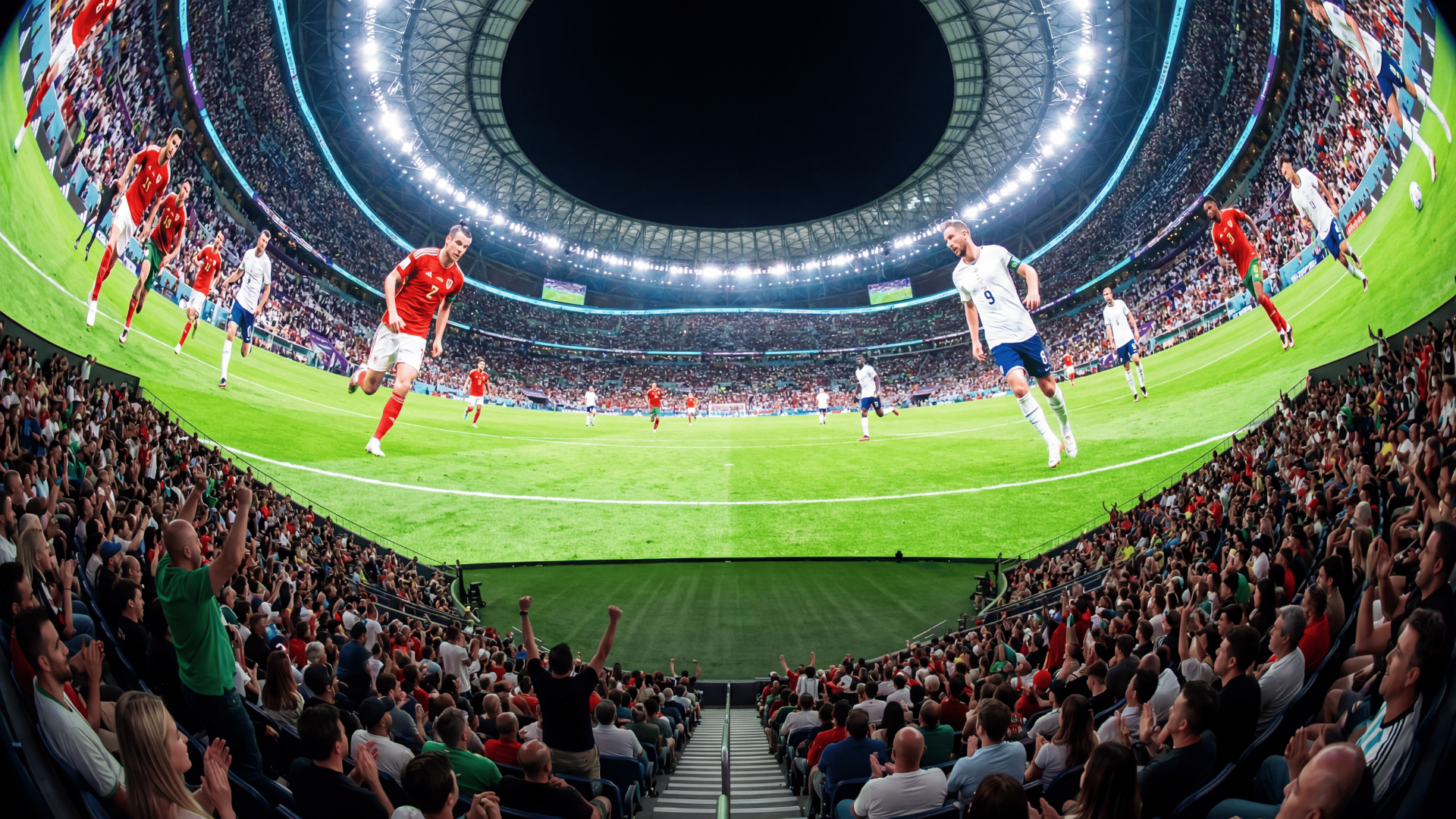
360° fan viewing domes
Imagine watching a match inside a spherical projection space the pitch surrounds you, the crowd noise comes from every direction, and the camera follows the ball from angles television never shows. You're not watching from a seat. You're in the stadium, without being in the stadium.
Example 02
Augmented reality city trails
Host cities become part of the experience. Walking through Mexico City or Los Angeles, you point your phone at a landmark and unlock the story of a legendary player who trained there, or a visualization of a historic goal layered on top of the real world, blending football history with the places you're already in.

Example 03
Multisensory World Cup fan zones
Not everyone can get a ticket. But a fan zone that responds to the match in real time lights shifting with momentum, haptic floors that vibrate on a goal, scent diffusers that fill the air with cut grass and adrenaline turns a public square into something genuinely electric.

Example 04
First person player simulations
What does it feel like to take a penalty in a World Cup final? VR and motion capture technology can put you inside that moment real crowd noise, real pressure, real goalkeeper reactions. It's not a video game. It's a window into an experience most people will never have.
Why this moment, why world cup 2026?
Immersive experiences aren't new. But three things make the 2026 World Cup uniquely fertile ground for them.
First, the audience is global but the venues are local. The tension between watching from home and being there in person has never been higher which means there's enormous demand for middle ground experiences that feel closer to "being there" than a television broadcast ever could.
Football is already one of the most emotional things humans do together. Immersive technology doesn't manufacture that emotion it amplifies what's already there.
Second, the three host countries bring genuinely different cultural relationships with football. Mexico's passion is visceral and communal. The United States brings scale and production ambition. Canada brings an outsider's hunger to prove itself. The opportunity to design experiences that reflect those differences rather than flatten them into one generic event is enormous.
And third: the technology is finally ready. Real-time AR, spatial audio, haptic feedback, AI-generated personalization all of it has matured enough to be deployed at event scale without feeling like a prototype.
The bigger picture
When we talk about immersive experiences at the World Cup, we're really talking about something more fundamental: the future of how humans gather around shared moments.
Sport has always been one of the most powerful vehicles for collective emotion on the planet. The question immersive experience designers are asking and the question that makes 2026 so exciting is: what happens when we stop treating that emotion as something to broadcast, and start treating it as something to architect?
The answer, if we get it right, isn't just a better fan experience. It's a new relationship between people and the events that matter most to them.
The 2026 World Cup will be remembered for its goals, its upsets, and its moments of collective joy. But it might also be remembered as the tournament where experiencing sport really experiencing it changed forever. That's an opportunity worth paying attention to.



.png)
